


Early life and education
An immigrant to the US, Jensen Huang was born in Taiwan in 1963. His family first relocated to Thailand and then later to the United States when he was just nine years old. Huang grew up in Oregon, where he graduated from Aloha High School. During his teenage years, he worked as a dishwasher, busboy, and waiter at a Denny’s restaurant.
Pursuing higher education, he earned a bachelor’s degree in electrical engineering from Oregon State University in 1984. During his time at Oregon State, he met Lori Mills, who happened to be his lab partner in an engineering course. After doing homework together on Sundays, the couple married in 1988.
In 1992, Jensen Huang went on to complete his Master’s in Electrical Engineering from Stanford University. Today, Jensen and Lori Huang have two children together, Madison and Spencer. Madison Huang is the Director of Product Strategy for NVIDIA Omniverse, and their son Spencer Huang is a Product Manager working on NVIDIA’s AI developer ecosystem.
Founding NVIDIA
Jensen Huang’s first job after graduating with his bachelor’s was at Advanced Micro Devices (AMD), where he worked as a product engineer designing and testing microchips. His early focus on memory and microprocessors gave him a head start in Silicon Valley’s semiconductor industry.
In 1993, in what seemed like a full-circle moment, Huang met fellow engineers Chris Malachowsky and Curtis Priem at a Denny’s restaurant to sketch the idea that became NVIDIA. When they incorporated the company (named from the Latin invidia, meaning “envy”), their mission was simple: to transform 2D gaming graphics into the immersive 3D visuals we now take for granted.
By the late 1990s, NVIDIA’s RIVA 128 and GeForce 256 had coined the term “graphics processing unit” and made the firm a leader in gaming technology. In the 2000s, CUDA (Compute Unified Device Architecture) turned GPUs into general-purpose computing tools, laying the foundation for modern AI.
The 2020s brought another leap with the Hopper and Blackwell GPU architectures, now powering the world’s largest AI models through partnerships with OpenAI, Anthropic, xAI, and Google DeepMind. While early NVIDIA GPUs helped enable OpenAI’s first experiments, the company’s role was one of supplying critical compute, not “gifting” hardware as sometimes claimed.
Today, Huang’s focus is on “physical AI” — the intelligent machines that will perceive, reason, and act in the real world. He predicts that within a decade, AI will be embedded in everything we own, from humanoid robots to autonomous vehicles and everyday devices.
From gaming to global AI
Under Huang’s leadership, NVIDIA stock has surged more than 2,000% over the past decade amid the global AI boom, placing his net worth at around $150 billion in late 2025. However, he maintains that this is only the beginning. Huang estimates that AI-driven robotics and automation could represent a $50 trillion global opportunity, creating entirely new industries and reshaping existing ones.
As an AI optimist, Huang believes that artificial intelligence will permeate every aspect of daily life, much like electricity or the internet once did. He often notes that a few decades ago, people had to take classes to learn basic computing, yet today, engaging with AI is as simple as opening an app. To accelerate adoption, he encourages individuals and organisations to “just start using it,” arguing that familiarity breeds understanding.
AI capital and stewardship
Compared to many billionaires, Huang is known for his modest lifestyle. There are no superyachts or private space ventures tied to his name. Instead, the vast majority of his wealth remains concentrated in his NVIDIA shareholding, where he owns roughly 859 million shares — about 3.5% of the company.
With NVIDIA briefly surpassing a $5 trillion market cap in October 2025, Huang’s net worth rose to an estimated $145–150 billion, placing him among the top five richest individuals globally. Roughly one-tenth of his stake is held directly, while the rest sits in long-term trusts and partnership structures designed for family succession and philanthropic continuity.
Jensen and Lori Huang also established the Jen-Hsun & Lori Huang Foundation in 2007, based in Palo Alto. The foundation now controls an estimated 69 million NVIDIA shares (worth over $10 billion), making it one of the largest private family foundations in the United States by assets.
The Jen-Hsun & Lori Huang Foundation
The Jen-Hsun & Lori Huang Foundation operates independently, without additional board members or staff. It maintains a discreet presence, with no official website or public grant application process. The foundation focuses on philanthropy in higher education, public health, AI-enabled medical research, STEM advancement, and community development, particularly on the West Coast and within the San Francisco Bay Area. In 2024, it announced a $100 million donation to the University of California, San Francisco (UCSF) to accelerate biomedical research through AI and advanced computing.
The Huangs place particular emphasis on institutions that shaped their own journeys. Notable donations include:
Oregon State University (OSU): In 2022, the Huangs donated $50 million to their alma mater to establish the Jen-Hsun and Lori Huang Collaborative Innovation Complex, an AI-powered research hub designed to inspire new generations of engineers and technologists.
Stanford University: Jensen Huang donated $30 million to build the Jen-Hsun Huang Engineering Centre, which now serves as a global hub for problem-solving and interdisciplinary collaboration.
Oneida Baptist Institute: In 2019, the foundation donated $2 million to fund Jen-Hsun Huang Hall, a girls’ dormitory and classroom complex in Kentucky, honouring the school Huang attended as a young immigrant.
Reflecting on his personal journey, Huang tells 60 Minutes interviewer Bill Whitaker:
“It is the most extraordinary thing, Bill, that a normal dishwasher, bus boy could grow up to be this. There’s no magic, it’s just 61 years of hard work every single day. I don’t think there’s anything more than that.” – Jensen Huang, NVIDIA CEO.
The Simple take
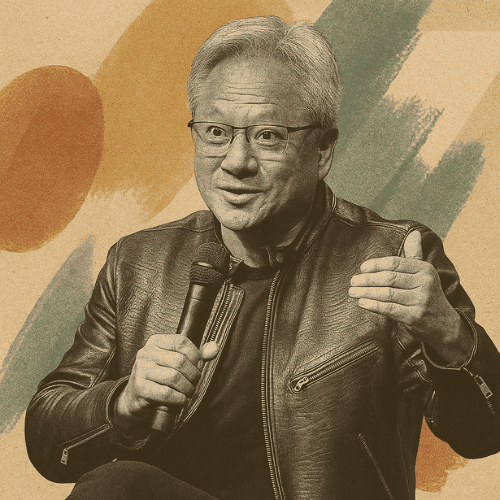
At 62, Jensen Huang is arguably Silicon Valley’s most in-demand voice on artificial intelligence. Dressed in his signature black leather jacket, the engineer-turned-visionary sees AI as a multi-trillion-dollar transformation, positioning NVIDIA as the world’s core infrastructure provider for intelligent computing. When he speaks, his passion is unmistakable. His wealth remains deeply tied to NVIDIA, where both of his children contribute to the company’s AI and Omniverse initiatives. If his vision for the next decade holds true, Huang’s 3.5% stake could make him the first engineer-CEO to surpass $200 billion in net worth, a reflection of how central AI has become to the modern economy.