



For decades, "defence" was the asset class that family offices kept at arm's length, somewhere between tobacco and that cousin who keeps asking for a bridge loan. You didn't discuss it at the dinner table, and you certainly didn't put it in the family newsletter next to the regenerative agriculture fund.
Defence was for governments, primes, and people who used the word "kinetic" without irony. That world has gone. What replaced it is messier, more interesting, and - for those willing to think clearly about it - considerably more lucrative.
Welcome to the age of dual-use technology, where the same drone that surveys your vineyard can also, in less peaceful circumstances, do something a great deal less agricultural.
Why dual-use?
Starting with the obvious. The most exciting technologies of the next two decades, artificial intelligence, autonomous systems, advanced materials, and space satellites, were never going to stay neatly in their civilian boxes.
As MIT's own framing of the term makes plain, ‘dual-use’ describes technology with legitimate commercial application and equally legitimate security application. The point is not that these tools are secretly weapons. The point is that the line was always artificial, and we have simply stopped pretending otherwise.
Unlike previous defence buildups, which largely recycled spending through legacy prime contractors, this one is flowing increasingly toward technology companies: software, AI, space, and sensing.
And why now?
The UK’s Strategic Defence Review (2025) commits to spending 2.5% of GDP on defence by 2027, explicitly calling out autonomous systems, AI, and space as priorities, and signalling intent to accelerate procurement from non-traditional dual-use suppliers rather than exclusively from primes.
The commercial logic is genuinely compelling. Dual-use businesses enjoy two demand curves instead of one: a commercial market that rewards cost efficiency and rapid iteration, and a defence market that rewards reliability and is, shall we say, not famously price-sensitive.
Innovation moves at the pace of the private sector while being de-risked by the deepest, most patient customer on earth - the State. Arthur D. Little, in its work on unlocking the strategic power of dual-use technology, makes the broader case neatly: this is where economic competitiveness and sovereign autonomy now converge. Countries that lead here don't just win battles. They keep their industrial base, their supply chains, and their bargaining power. Which is the part that should interest anyone managing capital across generations. This isn't a trade. It's a structural realignment of who funds frontier R&D and who captures the upside.
Defence isn't what it used to be
When most people picture defence, they picture hardware: tanks, jets, missiles, men shouting in formation. But the contested ground today is data centres, undersea cables, satellite constellations, payment rails, and the integrity of the code running all of it.
The battle has gone well beyond traditional combat. In fact, a considerable part of the battle is being fought by software engineers who have never owned a uniform or held a weapon. Modern conflict is sophisticated, distributed, and frequently invisible.
Cyber intrusion, disinformation, GPS spoofing, supply-chain sabotage - none of it fits the old mental model, and all of it is solved by technology that is, by its nature, dual-use. A cybersecurity firm protecting a data centre is protecting critical national infrastructure. A logistics-optimisation platform is a defence asset the moment a war disrupts a port. Defence got broader because the threats did. You can't address a multi-domain problem with single-use thinking.
The morality question, met head-on
Let's not pretend the discomfort isn't real. Many family offices have a genuine moral barrier here, and that deserves respect rather than a sales pitch. Concentric's own work on family-office perspectives, To Defend or Not to Defend found families landing in very different places, and that's healthy.
But the lazy resolution is to declare that "everything is dual-use these days," shrug, and write the cheque. That's not quite true, and it's worth being honest about it. A company building autonomous targeting systems is not in the same moral universe as one building flood-detection drones, even if both involve a quadcopter and a neural network.
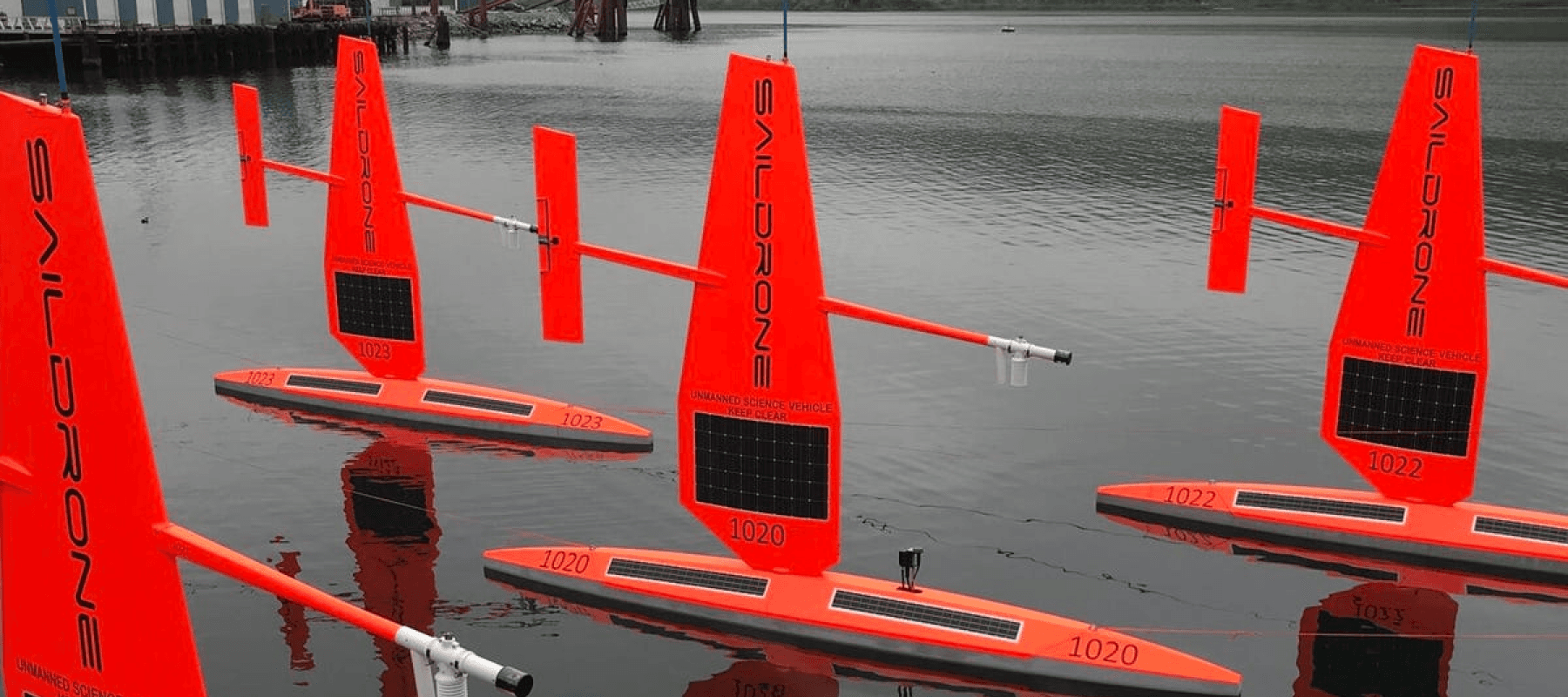
On one end of this universe’s moral axis, one may find Saildrone’s use by NOAA climate researchers, alongside the US Navy. At the other: an autonomous targeting platform with no civilian application whatsoever. Dual-use is a fine line between power and risk, and the responsible position is to actually look at where on that line a given business sits; its end users, its export controls, its governance - rather than hide behind a tidy slogan. The investable category isn't "anything with a defence angle." It's "technology that strengthens resilience and sovereignty, which you'd be comfortable explaining to the next generation." That's a narrower, better filter.
Why family offices specifically
So why are families, rather than the institutions, increasingly comfortable in this space? Four reasons. First, patient capital. Dual-use products often have long, regulated procurement cycles. Families can wait out a multi-year defence sales cycle in a way a fund nearing the end of its life simply cannot.
Second, exit diversification: strategic acquirers, sovereign buyers, and public markets all provide routes out, reducing reliance on any single liquidity window. Third, returns - frontier technology with a government underwriting demand is, on a risk-adjusted basis, an attractive place to be. And fourth, the next generation.
As Professional Wealth Management has observed, the next generation of principals is noticeably less allergic to defence and security than their predecessors, viewing resilience infrastructure as a legitimate, even necessary, expression of values-aligned investing.
Where venture capital does the heavy lifting
This is where specialist VC earns its keep, because the sectors are complex, technical, and the diligence is unforgiving. The clusters worth understanding, to mention a few:
- AI and cyber: The connective tissue of everything, from threat detection to autonomous decision-making.
- Drones and autonomous systems: The most visible expression of dual-use, equally at home in agriculture, inspection, and on the battlefield.
- Space: This is earth observation via satellite networks like Planet Labs, securing communications and positioning, from products that are now commercially viable rather than purely governmental.
- Biotech: Pandemic resilience, diagnostics, and biosecurity, a category that the last few years made unignorable.
- Advanced materials: The unglamorous foundation of every supply chain that geopolitics is now trying to reshore.
A good Venture Capital partner doesn't just provide access to these companies. It provides the export-control literacy, the regulatory navigation, and the end-use scrutiny that a family office should not be improvising on its own.
This is structural, not cyclical
The temptation is to treat all this as a moment - a spike driven by current geopolitical events that will subside once headlines calm down. That reading is wrong.
The reshoring of supply chains, the contest over critical technology, and the redefinition of national resilience are decade-long shifts, not a cyclical blip. The capital allocated to them should be sized accordingly.
Conclusion: From dual-use to omni-use
Here's where I will plant a small flag. The term "dual-use" is already too modest. As family offices accelerate into alternatives and private markets generally - and as the technologies in question quietly embed themselves in energy, communications, logistics, finance, and health - the duality framing undersells the reality.
These tools aren't used in two places. They're used everywhere. And their versatility stands as a strategy instead of a fenced category. Perhaps it's time we retired "dual-use" and called it what it's becoming: omni-use. Less catchy, admittedly. But more honest - and honesty, in this particular corner of the market, is the only acceptable direction.