



Early life
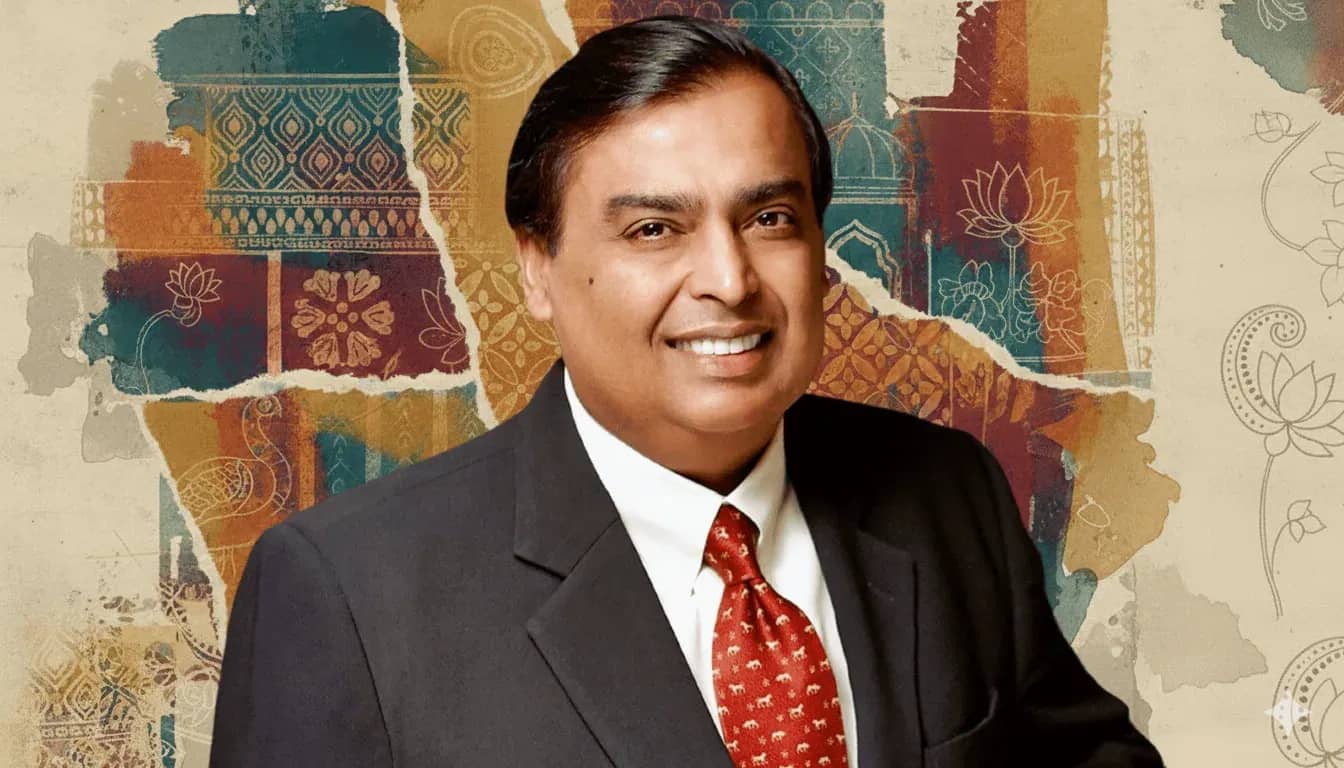
Mukesh Ambani’s path from a modest two-room apartment in Mumbai to the helm of India’s most powerful conglomerate is a testament to his father’s vision and his own disciplined execution. Born in 1957 to entrepreneurial father Dhirubhai Ambani, the founder of Reliance Industries, Mukesh grew up in an environment where resourcefulness was a necessity. He sharpened his entrepreneurial instincts, and his father encouraged his ambition from a very young age.
He studied chemical engineering at the Institute of Chemical Technology in Mumbai. Then he briefly attended Stanford’s MBA program, where Steve Ballmer of the Ballmer Group was a classmate. However, he was forced to drop out and return to India to join the family business. It’s noted that his father believed experiences were learned on the job, not behind a classroom desk. In 1985, he married Nita Ambani and the couple has three children.
The family business
Mukesh’s father, Dhirubhai Ambani, started Reliance Textiles in 1957 with a dream to create the biggest company in India. It began as a small trading business focused on exporting spices and importing textiles. Twenty years later, the company launched its first IPO in 1977. By far the biggest in India, the IPO issue was oversubscribed seven times.
With the capital inflowing, the family business expanded, underwent multiple M&As and name changes. It grew from a simple import and export firm into a multi-sector giant spanning energy, retail, telecom, and digital services. Dhirubhai continued to run the daily operations, with his eldest son Mukesh and younger son Anil Ambani by his side, up until he suffered a stroke in 1986.
The two sons continued to run the business operations together until their father passed away in 2002. Following their father’s passing without a clear succession plan, the brothers had a bitter feud over the family empire. It was not until 2005 that their mother intervened to mediate. She brokered a deal to split the conglomerate into two parts. Mukesh got Reliance Industries, and Anil got his fair share. Though Anil had to file for bankruptcy in 2020, he is estimated to be worth $1 billion and remains one of the richest people in India today.
Grand ambitions
Under Mukesh’s leadership, Reliance Industries reached new levels. The company cornered India’s telecom sector, offering low-cost data that triggered mass internet adoption. This happened to coincide with the nation becoming one of the world’s fastest-growing major economies. The spin-off of such a feat led to Reliance Industries controlling the upstream, midstream, and downstream segments of the telecoms market. Today, Reliance Industries is India’s largest public company in revenue and market capitalisation.
“I have always believed that India’s future will be defined by our ability to transform challenges into opportunities.”— Mukesh Ambani.
Continuing to honour his father’s legacy, Mukesh has positioned Reliance Industries as a beneficiary and architect of India’s next growth phase. In 2022, he made an $80 billion commitment to renewables. Looking ahead, he is not only hedging against fossil fuel decline but also making an aggressive move to dominate one of the century’s most critical industries. Reliance is building an integrated green energy ecosystem, from solar manufacturing to storage systems and hydrogen facilities. And his personal ambition is that “Reliance will become a net carbon-zero company by 2035.”
The family office
In 2022, Mukesh and his wife established a dedicated family office branch in Singapore. Having learned his lessons in life, Mukesh recognised the need to professionalise wealth management outside the corporate structure. His family office manages international investments, with a particular focus on technology and venture opportunities in Southeast Asia. It also gives the family access to Singapore’s robust regulatory regime, tax advantages, and deal flow.
For Mukesh, separating family wealth from Reliance’s operating businesses provides diversification and clearer succession planning. Not wanting to repeat his father’s mistakes, Mukesh has taken a proactive approach to succession. His three children each lead major verticals within Reliance Industries. The eldest son, Akash Ambani, leads the company’s mobile and broadband services arm. And his youngest son, Anant Ambani, is known for his work in the energy sector and his philanthropic efforts.
Global influence
Ambani’s story is deeply tied to India’s growth, but his strategy is borderless. Reliance has raised capital and forged alliances with some of the world’s most powerful brands, including Google and Meta, which invested in one of its subsidiaries, Jio Platforms. These partnerships delivered more than funding—they embedded Reliance in global innovation ecosystems and accelerated its digital strategy.
Reliance Retail has also forged collaborations with international brands, giving global companies access to India’s massive consumer market while enriching Reliance’s offering. Each partnership is structured to create mutual advantage: Ambani provides scale and distribution, while global players deliver technology, expertise, or brand recognition.
The family office’s Singapore expansion complements this global orientation. By establishing a base outside India, Ambani positioned his family closer to Southeast Asia’s fast-growing markets and international investment networks. And yet with one foot out, one remains firmly set on India’s soil with Mukesh and Anita’s Reliance Foundation.
The family foundation, founded in 2010, has positively impacted millions of Indians across the region. Also, its extensive work covers education, healthcare, rural transformation, sports, disaster management, arts and culture, and significant COVID-19 relief efforts.
“I assure you that in every challenge that India faces, Reliance Foundation has and will continue to stand with every Indian. Together we shall overcome as we always have.” – Nita Ambani
Five takeaways for family offices
- Infrastructure-first enables scaling: Anchoring wealth in tangible, scalable platforms like telecom and green energy builds durable moats across market cycles, as seen with Reliance’s expansion.
- Diversify strategically with optionality: Expansion into adjacent sectors such as energy, retail, telecom, and digital services strengthens resilience and unlocks compounding returns, demonstrated by Reliance’s multi-sector growth.
- Separate corporate and family wealth: Dedicated structures, like Mukesh Ambani’s family office in Singapore, provide governance clarity, diversification, and flexibility for international investments and clearer succession planning.
- Invest where macro and mission converge – Geographic and sector bets aligned with policy and societal needs, such as India’s economic growth and the global shift to renewables, enhance impact and returns.
- Plan succession as a strategic process, not an event – Phased transitions, with Mukesh Ambani’s children leading major verticals, safeguard cohesion and vision across generations, avoiding past mistakes of unclear succession.
Closing line
Mukesh Ambani’s approach serves as both a cautionary tale and an inspirational model for family offices managing public enterprises. His remarkable problem-solving skills—such as investing for the future, institutionalising family assets, and effectively planning for succession—demonstrate how his family’s entrepreneurial ethos can catalyse both legacy preservation and national progress. Indeed, he exemplifies the blueprint for those aiming to harmonise generational continuity with ambitious, forward-thinking expansion.