




The Simple View on Trusted AI for Family Offices
A research agenda for the structural shift in how family offices operate, govern, and build.
A research agenda for the structural shift in how family offices operate, govern, and build.
Published by Simple | 2026
Introduction
For six years, Simple has studied how family offices adopt technology. During that time, the core question has steadily evolved. It began as a question about software: which platforms do offices use, and how well do they work? It has evolved into one of data: do we trust our information enough to act on it? As AI systems move from assistive tools to agents capable of acting on behalf of the office, the question becomes organisational. How does the office itself need to change to successfully capture the power of this technology?
This shift is structural. Agentic AI – systems that can observe, plan, and execute tasks with limited human oversight – alter the calculus of staffing, infrastructure, governance, privacy, legal exposure, and the way an office interfaces with every external provider. This shift creates pressure across every function of the office simultaneously. A principal in Zurich asks whether their data is safe in a US-hosted AI model. A family office in Singapore discovers that three staff members are already using AI tools through personal accounts. An operations lead in London realises that their fund administrator cannot integrate with the automation the office is building. These are all different angles of the same transition.
The pace of development has outrun most offices' ability to evaluate. New models, tools, and capabilities are released weekly. The offices making progress share a common trait: they are treating this as an organisational transition. They ask questions about their people, processes, and principles before they ask about products.
This paper maps this terrain. It examines seven dimensions of family office operations where agentic AI creates both opportunity and risk: people, processes and workflows, technology and infrastructure, governance, privacy and security, legal and regulatory exposure, and the evolving relationship with service providers. It also addresses how these changes affect the operational dimensions of investment management, the core activity of most family offices.

The purpose is to frame the questions that matter, identify where structured research is needed, and set the direction for deeper work. Each area will be the subject of dedicated research in the months ahead, drawing on public sources, Simple's library of several hundred conversations with family offices globally, and targeted expert input.
No one else is doing this work, for this audience, with this combination of operational understanding and technology depth. That is why Simple is doing it.
Simple's prior work.
This white paper builds on a foundation of prior research, including Simple's 2026 outlook, which identifies eight structural themes shaping family offices; the analysis of the AI adoption paradox in family offices; and over two dozen articles published through Simple Signals since late 2025. Simple's annual Software and Technology Report, Service Design Report, and Security and Risk Report also inform the analysis throughout.
Citi Wealth, 2025 Global Family Office Report
People
The workforce question is the one most offices feel first. Family offices operate with small, versatile teams. The typical office employs fewer than fifteen people, and many run with five or fewer (Deloitte 2024; KPMG Agreus 2025). Staff in these environments carry broad responsibilities: a single person might handle investment reporting, coordinate with external advisors, manage family communications, and oversee the technology stack. Research from KPMG and Agreus found that 84% of family office employees believe they perform a hybrid role (KPMG, Agreus, 2025). Working in a family office has long required wearing multiple hats, and AI accelerates this trend.
Hiring questions change when an office can deploy an agent to handle document summarisation, meeting preparation, research synthesis, or first-draft communications. Consider a European single-family office that previously employed a full-time analyst to prepare quarterly investment summaries, reconcile data across custodians, and compile board packs. With AI tools taking the first stab at each of these, the office now needs someone who can manage the output they produce.
This creates a new competency. The skill is agent management: the ability to design effective prompts, evaluate AI-generated output with appropriate scepticism, orchestrate workflows that combine humans and machines, and know when to trust the system and when to override it. The people who develop this competency become force multipliers. An office of five, where three people are skilled at working with AI, can operate with the output capacity of a much larger team. Conversely, the risk of poorly managed AI – output that sounds confident but contains subtle errors – is particularly acute in an environment where the stakes are high, and the margins for error are thin. Anthropic's research on AI in the workplace found that AI-generated output can increase confidence without a proportional increase in accuracy, a dynamic that demands genuine active oversight skills (Anthropic Economic Index, 2025).
Hiring itself is also changing. AI tools can screen candidates, match skills to requirements, and surface patterns in application data that human reviewers might miss. Some of this is useful. Some introduce bias in ways that are difficult to detect (Castilla, 2025). A family office considering AI-assisted recruitment needs to understand both the capabilities and the limitations, particularly given the sensitivity of the information these offices handle and the level of trust required in every hire.
Deeper questions emerge about the principal's own role. In a small office, the principal is often both the strategic decision-maker and an active participant in daily operations. When AI systems can draft analysis, surface options, and recommend courses of action, where is the principal's judgment most needed? How does the decision-making process change when the first version of any recommendation comes from a machine?
Simple's prior work. Simple has covered the workforce dimension of AI across several pieces, including analysis of how shadow AI adoption reveals the absence of stated AI policies, the implications of AI-driven shifts in how skills and roles are evaluated, and the three hats family offices wear as operators, investors, and owners. Simple also examined the distance between interest and implementation in bridging the AI gap for family offices. Data points from the Software AG Chasing Shadows report, KPMG/University of Melbourne global workforce surveys, and Anthropic's research on AI's impact on work inform the analysis.
Where the research goes next. Simple will publish dedicated research on people in the agentic AI era, examining hiring practices, team structure, skills development, agent management as a discipline, and the evolving role of the principal in an AI-augmented environment.
Processes and Workflows
Before an office can effectively adopt AI, it needs to understand how its existing infrastructure works. This sounds obvious. Yet, in practice, most family offices have never formally documented their operational processes, institutional knowledge lives in the heads of a few key people, and workflows are understood through habit rather than design. When someone leaves, so does a significant portion of the office's operational intelligence.
Integrating AI makes this visible. The act of preparing a workflow for automation requires precise description: what triggers it, what data it needs, what decisions are involved, who reviews the output, and what happens when something goes wrong. One family office Simple spoke with discovered that when they began mapping their quarterly reporting process, the workflow depended on a single person's knowledge of which data sat in which custodian portal and how to reconcile discrepancies between them. That knowledge had never been written down. Many offices find the same when they begin this exercise. The process of preparing for AI becomes a diagnostic in its own right.
The question of what to automate also deserves more care than it typically receives. Various frameworks point to four dimensions: the sensitivity of the data involved, the frequency of the task, its complexity, and the cost of errors. A task that is frequent and low-sensitivity, such as summarising publicly available data, is a strong candidate for full automation. A task that involves confidential family information and has significant consequences if done incorrectly, such as preparing tax filings or drafting legal correspondence, may benefit from AI augmentation while retaining human oversight.
The offices making the most progress tend to share a common approach: they start with one workflow, not twenty. They pick a single, bounded process, often something like meeting note summarisation, research digests, or draft email generation. They run it through an AI tool for a fixed period with clear boundaries on what data enters the system. They evaluate the results, and they let the learning from that single workflow inform their approach to the next one. This is a disciplined, sequential adoption rather than broad experimentation. RSM observed in a 2025 analysis of family office AI readiness that the shift should be from apprehension to readiness, and a bounded pilot is how that shift begins (RSM, Strategic AI Readiness in the Family Office, 2025).

At a higher level, AI changes how the office delivers its core services. Investment reporting, tax coordination, estate administration, philanthropic management, and family communications all contain, to varying degrees, significant repetitive elements that AI can handle. The question then becomes how the service delivery model changes when agents clear the repetitive layers, and what the people in the office focus on instead. The answer, in most cases, is through offering judgment, relationships, and the kind of contextual understanding that AI systems do not yet reliably provide.
Simple's prior work. Simple's workshops have consistently found that successful adoption starts with one workflow, and that process mapping is the step most offices skip. The permission to begin outlines practical approaches for starting AI experimentation within bounded conditions. Where does your knowledge live? explores how institutional knowledge is held by individuals rather than systems, and why that matters before AI can be effective. Simple also laid out seven steps for building your single-family office AI strategy, providing a practical entry point. Well-established models of family office service categories, developed over decades of industry practice, provide the foundation for mapping AI applications to specific operational areas.
Where the research goes next. Simple will publish dedicated research on processes and workflows, mapping family office service models against available AI applications, developing frameworks for evaluating automation readiness, and documenting how offices are sequencing their adoption in practice.
Technology and Infrastructure
Technology decisions made now will shape an office's flexibility for years. Deep commitment to a single provider risks lock-in; avoiding commitment risks falling behind. The goal is an infrastructure that absorbs change without creating fragility.
The central decisions reside in the stack: where AI processing happens, who controls the data, and which dependencies the office accepts. The options range from fully cloud-based services, where data is sent to external providers for processing, to fully local deployments, where models run on hardware owned and controlled by the office. Most offices will land somewhere in between, using cloud services for some tasks and local processing for others based on the sensitivity of the data involved.
Self-hosted models are increasingly viable. Open-source models running on consumer hardware, particularly Apple silicon, now offer meaningful capability for many of the tasks a family office performs daily. Document summarisation, research synthesis, draft communications, and basic analysis can all be handled locally. The gap between locally hosted models and the leading cloud-based systems is closing, though for the most demanding tasks: complex reasoning and large-context analysis, cloud-hosted models still hold an advantage (UK AISI, 2025). The question for each office is whether that advantage justifies the data exposure that comes with it.
This is what "sovereign AI" means in practical terms for a family office. It is an architectural position: the office controls where its data is processed, under what terms, and with what ability to change providers if circumstances shift. Recent geopolitical developments concretely illustrate why this matters. Governments have shown an increasing willingness to compel technology companies to grant access to data held within their jurisdictions, including through instruments like the US CLOUD Act. In 2025 and 2026, growing tensions between the US and other regions led some European governments and organisations to re-evaluate their complete dependence on US-based AI providers. Several families Simple has spoken with have moved critical workflows off Microsoft and other US platforms in response. An office that depends entirely on a single cloud provider in a single jurisdiction is accepting a concentration of risk that may not align with its broader approach to resilience.
Data readiness sits underneath all of this. Before any AI tool can be effective, the data it works with needs to be accessible, structured, and of sufficient quality. Many offices discover that their data is fragmented across systems, inconsistently formatted, and poorly documented. The work required to bring data into a usable state is significant and unglamorous, but it is the foundation on which everything else depends.

Simple has published an annual Software and Technology Report for several years, assessing the state of the family office technology landscape. That work now evolves naturally into a broader assessment of technology infrastructure through the lens of agentic readiness: which platforms support AI integration, which are building toward agentic interoperability, and which show signs of falling behind. This assessment will include a qualitative readiness framework, a way for offices to evaluate the maturity of AI applications across their core service areas and identify where deployment is practical today, where caution is warranted, and where the technology needs further development.
Simple's prior work. Simple's coverage of sovereign AI for family offices examined why control over data processing is a practical necessity. The analysis of switching costs and memory portability explored what happens when an office needs to move between providers. Three family office tech camps, all with the same problem, mapped the different starting points offices occupy and why no single AI tool covers the full surface area. Simple also published the articles *Is your family office software ready for AI?* and *AI in family office software: from hype to implementation* directly addressing technology evaluation. Simple's annual Software and Technology Report provides the baseline evaluation of the family office technology ecosystem.
Where the research goes next. Simple will publish dedicated research on technology and infrastructure, including an updated readiness assessment framework, practical guidance on self-hosted and hybrid architectures, and an evolution of the annual Software and Technology Report into a broader evaluation of agentic readiness across the family office stack.
Governance
Family office governance has always been about structure, accountability, and decision rights. Who has the authority to act? Within what boundaries? Subject to what oversight? Family offices address these questions through documents and processes developed over decades: family constitutions, investment policy statements, board mandates, advisory committee charters, and operating agreements.
AI extends them into new territory. The governance framework needs to account for when an agent can draft a recommendation, prepare a report, or execute a transaction. Who authorises an agent to act? What boundaries apply? What happens when the agent makes an error? How is its performance reviewed? Who is accountable?
Most offices have not yet addressed these questions. Based on our data, most use AI without having a proper policy in place. There is no ban on AI use and there is no stated position on what is acceptable, what data can be shared with AI systems, or who is responsible for reviewing AI-generated output. Into that silence, individuals make their own decisions. Over half of knowledge workers globally use AI tools not provided by their companies (Software AG, Chasing Shadows, 2025), and 47% of people using generative AI platforms do so through personal accounts not overseen by their employers (Netskope, 2025). Staff use what helps them get the job done. This is the natural consequence of capable people solving real problems without guidance.
The minimum viable response is a one-page AI use policy. A single page that answers the questions the team is already asking: what data categories are off-limits for external AI tools? Which tools are approved, and for which tasks? Who reviews AI-generated output before it is used? What gets escalated? The purpose of this document is to replace silence with clarity. It gives the team permission to act within defined boundaries.
The more interesting governance question is what happens to existing governance documents in an agentic environment. A family constitution that articulates the family's values, investment philosophy, and decision-making principles has traditionally served as a reference document, consulted periodically and interpreted by family members. The same document now becomes a potential input to AI systems. The values and principles it contains can inform how agents behave, what they prioritise, and what constraints they operate under. Consider a constitution that states a commitment to sustainable investing: where an investment team once weaved this principle into broader judgment, an AI system can encode it as a hard constraint, applying it automatically when screening deals or generating research.
Governance principles applied consistently and automatically across the office's operations is a powerful proposition. The risk is that the nuance and judgment that have always accompanied the interpretation of these documents are lost when they become system inputs. A governance framework designed for the agentic era needs to hold both.
Simple's prior work. Simple's analysis of the AI policy gap in family offices documented how the absence of a stated position on AI is itself the most consequential decision an office can make. Other articles, such as future-ready family office AI examined the intersection directly, and the AI strategy and governance guide provides a practical framework. Onboarding AI like a human explored why the same instincts that guide how offices bring in new people, context before capability, now apply to AI systems. Data from KPMG, Software AG, and Netskope establishes the scale of unsanctioned AI adoption in small, high-trust teams.
Where the research goes next. Simple will publish dedicated research on governance in the agentic era, examining how governance frameworks are adapting, documenting emerging best practices, and developing practical guidance for offices at different stages of AI adoption. This includes the minimum viable AI policy, the integration of existing governance documents with AI systems, and the evolving question of decision rights when agents can draft, recommend, and execute.
Privacy and Security
Privacy is foundational to the family office model. The entire premise of the structure is that it provides a level of discretion and control that other wealth management arrangements do not. AI escalates every facet of this: where data is processed, who can access it, how long it is retained, and what new attack surfaces emerge when systems become more autonomous.
The most immediate dimension is data sovereignty. When an office uses a cloud-based AI service, the data it sends for processing travels to servers in a specific jurisdiction, is handled according to that provider's policies, and may be retained, used for model training, or made accessible to authorities under that jurisdiction's laws. Some providers offer zero-retention options, where data is processed and immediately discarded. Others use customer data to improve their models unless the customer explicitly opts out. The practical difference is significant. An office that sends a confidential family trust document to a cloud-based AI service with default settings may be contributing that document to the provider's training data. Whether the same office uses a zero-retention API or processes the document locally, it retains full control.
The trade-off between privacy and capability requires conscious decision-making. The most powerful AI models today are cloud-based. Using them means sending data externally. Local-first processing, where data stays on hardware controlled by the office, is the most conservative approach. Air-gapped systems, where the hardware running the AI model has no internet connection, provide the highest level of isolation. Zero-retention APIs offer a middle ground. Synthetic data, artificially generated datasets that mimic the structure of real data without containing any genuine information, allows offices to test AI tools without any real exposure. Each of these patterns has implications for capability, cost, and complexity.
This trade-off does not need to be made once for the entire office. Different tasks warrant different approaches. Summarising publicly available research can safely use a cloud-based model. Analysing confidential family financial data probably should not.
New threats are also emerging. Anthropic’s most capable model to date – Claude Mythos Preview – can identify thousands of high-severity zero-day vulnerabilities across every major operating system and web browser. Anthropic judged the capability significant enough to restrict public release entirely, limiting access to a vetted partner program (Anthropic, Project Glasswing, 2026). For family offices, the practical implication is that vulnerability discovery is becoming an automatable process. As open-source models catch up in terms of cybersecurity capabilities, hackers will find it increasingly easy to deploy them without guardrails.
This is amplified by an eager adoption of “vibe-coding” – using AI to generate code, often by people with little technical knowledge (GitHub, 2025). This tends to create unvetted attack surfaces that aren’t systematically reviewed. Quantum computing presents a longer-horizon risk: advances in quantum hardware are expected to place pressure on current encryption standards by the 2030s (NIST, 2024), and offices storing sensitive data under those standards should factor this into long-term infrastructure planning.
When agents can access systems, draft communications, and move information between platforms, the attack surface expands. An agent with access to the office's email, calendar, and document management system has a level of access that would require careful vetting if granted to a human employee, and the security frameworks that govern agent access, authentication, and monitoring are still developing.
Simple's prior work. Simple's analysis of sovereign AI for family offices and the permission to begin addressed practical approaches to privacy-conscious AI adoption, including synthetic data testing, air-gapped pilots, and zero-retention API evaluation. Simple’s *Security & Risk Report 2025* provided a dedicated assessment of the security landscape for family offices. PwC's characterisation of current family office AI adoption as "citizen-led" (PwC / Family Wealth Report panel, 2025) and Simple's own finding that 41% of family offices cite cybersecurity and privacy as the top barrier to AI adoption (Simple Software and Technology Report, 2025) provide the quantitative context.
Where the research goes next. Simple will publish dedicated research on privacy and security, examining privacy architectures, data sovereignty considerations, emerging cryptographic and social engineering threats, and security frameworks for agentic environments. This work will draw on technical analysis, regulatory tracking, and the practical experience of offices that have implemented privacy-first AI systems.
Legal and Regulatory
The legal landscape for AI is developing rapidly and unevenly. The EU has moved furthest with the AI Act, which establishes risk-based obligations for AI systems, AI literacy requirements for organisations deploying them, and transparency rules that take effect from August 2026 (EU AI Act, Reg. 2024/1689). GDPR continues to set the baseline for data protection in Europe, and the interplay between the AI Act and existing data protection regulation is still being worked out in practice. In the United States, regulation is emerging at the state level rather than the federal level, with Colorado (SB 205), Texas (RAIGA), and other states introducing frameworks that vary in scope and stringency.
For a multiple-jurisdictional family office, this creates a layer of complexity. Consider an office with a holding company in Switzerland, a trust in the Cayman Islands, and principals in the United States. It faces at least three distinct regulatory regimes, each with different requirements for data handling, AI transparency, and accountability. The compliance question multiplies when that office deploys an AI tool that processes data across all three jurisdictions. Designing an AI-enabled operation that satisfies all applicable requirements is possible, but it requires the regulatory landscape to be part of the design process from the start.

The legal question bifurcates. The first is compliance: what obligations does the office face when it uses AI systems, and how should those obligations shape technology and governance decisions? The EU AI Act's Article 4, for example, requires organisations deploying AI to ensure sufficient AI literacy among their staff, a requirement that most family offices have not yet implemented in their training programmes. The second dimension is opportunity: how can AI improve the office's own legal operations? Contract review, regulatory monitoring, compliance tracking, and legal research are all areas where AI tools are increasingly capable. The evidence suggests that meaningful time efficiencies are available today, though expert oversight remains essential. The economics of legal services are already shifting. When KPMG, one of the world's largest accounting firms, negotiated a 14% fee reduction from its own auditor, Grant Thornton, arguing that AI should make audit work faster and cheaper, it signalled a dynamic that will reach every professional services relationship a family office maintains.
Beyond using AI within legal workflows, offices are beginning to explore AI tools for ongoing compliance monitoring, contract lifecycle management, and regulatory change tracking across jurisdictions. Legal accountability is the area where the least clarity exists. When an AI system makes an error with legal or financial consequences, the question of who bears responsibility remains unsettled in most jurisdictions. Existing family office liability structures, which assign responsibility to specific individuals and entities, do not map cleanly onto a world where some decisions are made or influenced by AI systems. This will be resolved through a combination of regulation, case law, and contractual arrangements, but in the interim, offices need to think carefully about where they allow AI systems to operate without human review.
Simple's prior work. Simple has drafted a dedicated analysis of the EU AI Act's implications for family offices, covering Article 4 literacy obligations, Article 50 transparency requirements from August 2026, and Annex III high-risk triggers that may apply to offices using AI in financial decision-making. The gap between the pitch and the proof examines why the AI marketing machine is outpacing the evidence, a dynamic that makes regulatory literacy essential. The sovereign AI analysis explored how compliance considerations differ between cloud-hosted and self-hosted AI deployments. The Field Notes piece on law, Mythos, and the AI legal landscape covered emerging developments in AI-assisted legal services. On the main site, legaltech for family offices and future-proof your family office with legaltech provides a deeper context on how legal technology is evolving for this sector.
Where the research goes next. Simple will publish dedicated research on the legal and regulatory landscape, tracking evolving frameworks across key jurisdictions, examining practical approaches to cross-border compliance, assessing the maturity of AI tools for legal workflows, and developing guidance on liability and accountability in the agentic era. This is the most regionally specific of the research areas, and future reports may include regional supplements or jurisdiction-specific analysis.
Service Providers and Procurement
A family office sits at the centre of a network of service providers: lawyers, accountants, tax advisors, bankers, custodians, technology vendors, and a range of specialist consultants. The quality of these relationships has always been a defining factor in the office's effectiveness. AI is changing these relationships in ways that are already playing out in specific, observable ways.
The immediate changes are visible in pricing and capability. Bankers who have invested in AI-assisted document review can turn around with KYC approvals faster than those who have not. Accounting firms that use AI for reconciliation and anomaly detection can offer more responsive service at a lower cost. Fund administrators who have built API-first architectures can interface with an office's automation stack, while those relying on manual data exchange create bottlenecks. These are practical differences that affect the office's operations today. And a provider that is not investing in AI capabilities today may also be unable to keep pace with the office's needs in two or three years.
The medium-term trajectory points toward agentic interfaces between offices and providers. Rather than exchanging emails and documents, the office's agents will interact with the provider's agents. Information requests, document reviews, compliance checks, and even elements of negotiation will happen through automated systems. Major technology platforms are already building the connectors that make this possible. Microsoft released a new agent connector framework in April 2026 (Microsoft, 2026), signalling the direction of travel. Dynamic pricing models, where the cost of a service adjusts based on complexity, volume, and market conditions, become feasible when agents on both sides can negotiate in real time.
This also changes the build-or-buy calculus. When AI tools can handle tasks that previously required a service provider on retainer, the office needs to decide whether to bring that capability in-house, continue outsourcing, or adopt a hybrid approach. The answer will vary by service category, office size, and the level of expertise required. Legal advice that requires jurisdictional knowledge and professional judgement is unlikely to move fully in-house. Routine document preparation and regulatory monitoring may well do so.
Simple's prior work. Simple's annual Software and Technology Report (2025 edition) has assessed the family office technology and service provider landscape for several years. Can your suppliers keep up? explored why an office's AI transition depends partly on the AI readiness of its providers. The AI pricing correction Field Notes piece examined how AI is reshaping the economics of technology services, and the lurking services layer beneath AI highlighted how even the leading AI companies are investing heavily in human services infrastructure to make their products usable. The *Service Design Report 2024* mapped the family office service model in detail, providing the foundation for evaluating which provider relationships are most affected by AI.
Where the research goes next. Simple will publish dedicated research on service providers and procurement, extending the annual Software and Technology Report into a broader evaluation of provider AI readiness, examining the emerging dynamics of agentic procurement, and developing practical frameworks for how offices should evaluate, select, and manage providers in the agentic era.
Investment Management
Investment management is the core activity of most family offices, and a complete account of AI's impact must address it. Simple does not advise on investment strategy, and this is not a market report – the focus here is on the operational dimensions of investment management: how the work is structured, how information flows, and how decisions are supported.
AI is already changing how investment operations work. AI-enabled Portfolio monitoring tools can detect anomalies, surface relevant news, and generate natural-language summaries for family members. A family office Simple advises uses AI to produce weekly portfolio summaries in plain language for family members who are not investment professionals, replacing a process that previously took a staff member most of a day. Due diligence processes that once required weeks of manual document review can be significantly accelerated with AI-assisted analysis of fund documents, manager track records, and market data. Alternative data sources, from satellite imagery to social media sentiment, become accessible through AI systems that can process and synthesise information at a scale that human analysts cannot match.
The important distinction is between using AI to improve the operational infrastructure supporting investment decisions and using AI to make the investment decisions themselves. The first is practical and increasingly proven. The second raises questions about accountability, model risk, and the role of human judgment that are far from resolved.
Separating the two, however, may prove complicated. How do you remove bias from a research report and an AI model generated? Often, data used for pre-training is already structurally biased in one way or another.
Where the research goes next. Investment management operations will be addressed within the broader technology, infrastructure, and processes research rather than as a standalone report. The focus will remain on operational and infrastructure dimensions, consistent with Simple's positioning.
Cross-Cutting Themes
Several themes run across every dimension of this research and deserve explicit framing. They are not standalone research areas. They are lenses that apply throughout.
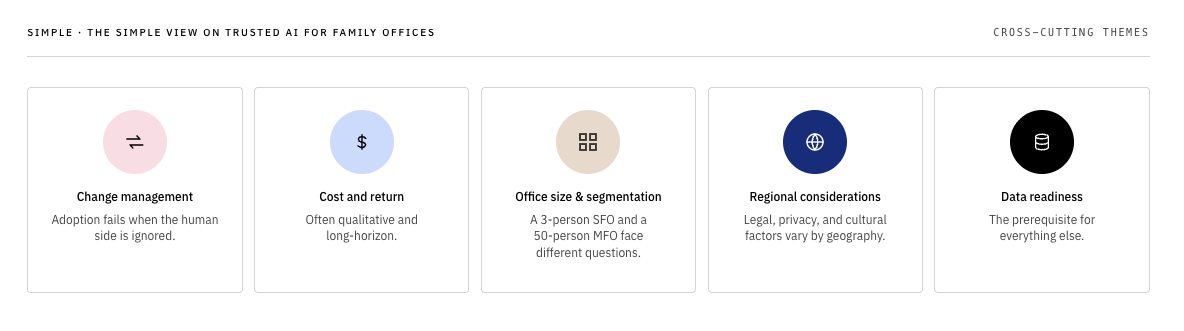
Change management and culture. Technology adoption fails when the human side is ignored in any organisation, but this carries particular weight in family offices. These are small, close-knit teams where trust and relationships are central to how work gets done. Introducing AI into this environment requires attention to the concerns, scepticism, and learning curves of the people involved. An office that forces adoption faster than its team can absorb will create resistance. One principal described it as "the difference between the team using AI because they want to and using it because they were told to." Training matters. Communication matters. The pace of change matters.
Cost and return. How to evaluate the return on AI investment is a question without a settled answer. Many of the benefits are qualitative: faster turnaround, reduced cognitive load, better-informed decisions. Some are quantifiable but emerge over long time horizons. An office that spends six months building an AI-assisted reporting workflow may not see a clear financial return for a year, but the compounding effect on staff capacity and decision quality may be substantial. Traditional technology ROI frameworks may not capture this accurately. This question will feature throughout future research, most prominently in the technology and infrastructure work.
Office size and segmentation. A single-family office with three staff faces fundamentally different questions than a multi-family office with fifty. The constraints: available resources, the complexity of operations, the regulatory requirements, and the risk appetite all differ. A three-person office may find that a single local AI model and a clear use policy is sufficient. A fifty-person multi-family office may need a layered architecture with different AI tools for different functions, formal governance processes, and dedicated oversight. The research will acknowledge this throughout rather than treating all offices as a single category.
Regional considerations. Legal, regulatory, and cultural factors vary significantly by geography. Some areas of this research, particularly legal and privacy, will require explicit regional treatment. Others, such as people and processes, are more globally applicable. Where regional differences are material, they will be addressed directly.
Data readiness. This is the prerequisite for everything. Before AI tools can deliver value, the data they work with needs to be accessible, structured, documented, and of sufficient quality. From the conversations Simple has had, most offices underestimate the work required to reach this baseline. Data readiness is foundational to all seven research areas, not a separate topic, and will be addressed within each.
The Research Ahead
This paper maps the terrain. The work that follows will go deeper.
Each of the seven areas outlined here will be the subject of dedicated research drawing on three tiers of input that, taken together, distinguish Simple's work from anything else available to this audience.
The first tier is targeted primary research: expert interviews on specific topics, guided conversations with family office practitioners through new collection mechanisms, and expert review of draft findings.
The second tier is Simple's own conversation library. Over the past two years, Simple has conducted several hundred conversations with family offices globally. These transcripts contain specific, grounded experiences: the pain points, the decisions, the successes and failures of offices at different stages of technology adoption. This first-party data is not available elsewhere and will inform the research throughout. The priority is to preserve the specific anecdotes and experiences that make research credible and readable, while also capturing the broader patterns and themes that emerge from the data.
The third tier is public sources: consultancy reports, emerging academic literature, technology company research, and regulatory publications. The body of relevant work is growing but remains fragmented across disciplines and audiences. Part of Simple's contribution is to synthesise it specifically for family offices.
Several additional factors position Simple to do this work in ways others cannot. Simple operates globally, working with offices across Europe, the Middle East, Asia, and North America, which means the research reflects diverse jurisdictional, cultural, and operational contexts rather than a single region's perspective. Simple's team combines practitioner experience in family office operations with a deep technical understanding of AI systems, a combination that is rare in this space.
The goal is rigorous, practical research grounded in the reality of how family offices actually operate. The offices that engage with it early will be better positioned to make the decisions that lie ahead.
This white paper is the first publication in Simple's 2026 research agenda on trusted AI for family offices. For updates on upcoming research, subscribe to Simple Signals at andsimple.substack.com or contact the team at Simple directly.
About Simple
Simple partners with family offices, navigating the transition to AI-augmented operations. Through research, advisory, and hands-on design and implementation, Simple helps offices explore what is possible, design solutions that fit their specific context, and build the skills and infrastructure to operate confidently in the agentic era.
About this research
This research agenda is led by Francois Botha and David Struthers, with contributions from the broader Simple team, community of experts and input from the user base of more than 12,000 users. It draws on Simple's proprietary research library, public research, and expert input from across the family office ecosystem.
For enquiries about participating in this research, contributing expert input, or accessing future reports, contact hi@andsimple.co.
Sources Referenced
- Anthropic, Project Glasswing, 2026
- Anthropic, The Anthropic Economic Index, 2025
- Castilla, AI is Reinventing Hiring – With the Same Old Biases, MIT Sloan Management Review, 2026
- Citi Institute / Citi Wealth, AI in the Family Office: Privacy, Efficiency and Institutional Rigor, May 2026
- Citi Wealth, 2025 Global Family Office Report, September 2025 (346 respondents, 45 countries)
- Deloitte, State of AI in the Enterprise, 2024/2026
- European Parliament and Council, Regulation (EU) 2024/1689 (Artificial Intelligence Act), 2024
- Financial Times, KPMG pressed its auditor to pass on AI cost savings, 2026
- GitHub, Octoverse 2025: The State of Open Source, 2025
- KPMG & Agreus, Family Office Compensation and Benefits Report, 2025
- KPMG & University of Melbourne, Global AI Adoption in the Workplace, 2025 (48,000 respondents, 47 countries)
- Microsoft, “Microsoft Agent Framework 1.0”, 2026
- Microsoft, Work Trend Index, 2025
- Netskope, AI Usage and Data Exposure Report, 2025
- NIST IR 8547, Transition to Post-Quantum Cryptography Standards, 2024
- PwC / Family Wealth Report, Family Office AI Adoption Panel, 2025
- RSM, Strategic AI Readiness in the Family Office, 2025
- Simple, Software and Technology Report, 2020-2025 (annual)
- Software AG, Chasing Shadows: Unsanctioned AI in the Enterprise, 2025