




Report
Family Office Software & Technology Report 2026
Family offices still do a lot of manual work, even those with tech solutions in place, and AI is starting to change that. Each edition of this report has looked at what family offices need and how technology meets it, alongside the people and processes around it. This year we look at where the gaps are, what's changing in the tech market, and how family offices, like other niche industries, can transform and adopt the latest tech & AI in the right way.



TL;DR
The report in brief
- Family offices are not short of software. What holds them back is clean data flowing between systems, and the people and time to make those systems work.
- AI is sold faster than it is used. Vendors talk about agents and connectors, while most offices still use AI as an assistant for email, documents and research.
- Building is back on the table. AI coding tools let offices build their own tools, which brings back the old question of what to build, buy or borrow.
- Trust decides how far AI goes. Privacy is the main AI worry and security is a buying criterion, so vendors now design and sell around both.
- Choosing and running software is still a people business. References and relationships drive selection, IT goes to outside providers, and vendors are starting to sell services alongside software.
Executive summary
The gap between what is sold and what is used is one of the clearest stories of the year. Vendors talk about agents and connectors to AI tools, while most offices still use AI as an assistant for email, documents and research.
Underneath it, family offices are not short of software. They are short of clean data flowing into it, and of the people and time to make new systems work.
Family offices and vendors agree more than they disagree. Both say the hard part is getting clean data in and between systems, not AI. Vendors point mainly at banks and custodians. Both say capacity inside the office is the biggest hurdle. There are other topics where the two sides see things a bit differently, and AI is the main one.
New pricing models. Some vendors are moving away from pricing by AUM, and say complexity, not asset size, decides fit. Token-based pricing from AI companies may push this further.
What offices use
- Reporting platforms are spreading, but spreadsheets and manual steps persist on top of them, and many vendors say the same.
- Where AI comes up, most offices use AI assistants for email, documents and research.
- Some offices hand IT to an outside provider.
- A few keep private-markets data outside their main platform, which fragments the systems they use.
How they use it
- Systems are the base, and people fill the gaps by hand: data moves between systems manually and reports are assembled on top.
- AI mostly sits at assistant level, where a person prompts each step. Fewer offices let AI complete a defined task that a person then checks, and the only agents we heard about in offices are ones the office built itself.
- Offices that describe formal controls around AI set a policy first, approve the tools and keep sensitive data apart from what AI can see.
Where the market is heading
- Vendors keep moving up the AI ladder. In our 2023 review, around 80% of the 35 providers we surveyed already included AI functionality in their products or planned to. In 2025, 92% used or were developing AI. That figure comes from the 40 software vendors who sent submissions to our 2025 report, so it is a different measure from a different group, not a trend from 2023. This year vendors talk about agents and connectors to AI tools, while offices mostly stay at assistant level, so the gap between what is sold and what is used is wide.
- Building comes back into the stack. In 2025 we saw cheaper development tools reshaping the vendor market. Offices now use the same tools to build their own front ends, and a few vendors answer by opening feeds and APIs. The pattern to watch is buy the plumbing, build the view.
- Vendors sell services as well as software. Some vendors now bundle data operations as a managed service, from daily reconciliation teams to an outsourced back office.
- Privacy becomes a product feature. Many vendors keep AI inside their own platform or out of sensitive work, and some sell data sovereignty as a feature.
- Buyers are unsure about established systems. With the market moving this fast, offices ask us whether to keep what they have or switch, and some vendors expect the legacy model to break or consolidate.
What's top of mind for vendors and family offices
The themes that showed up
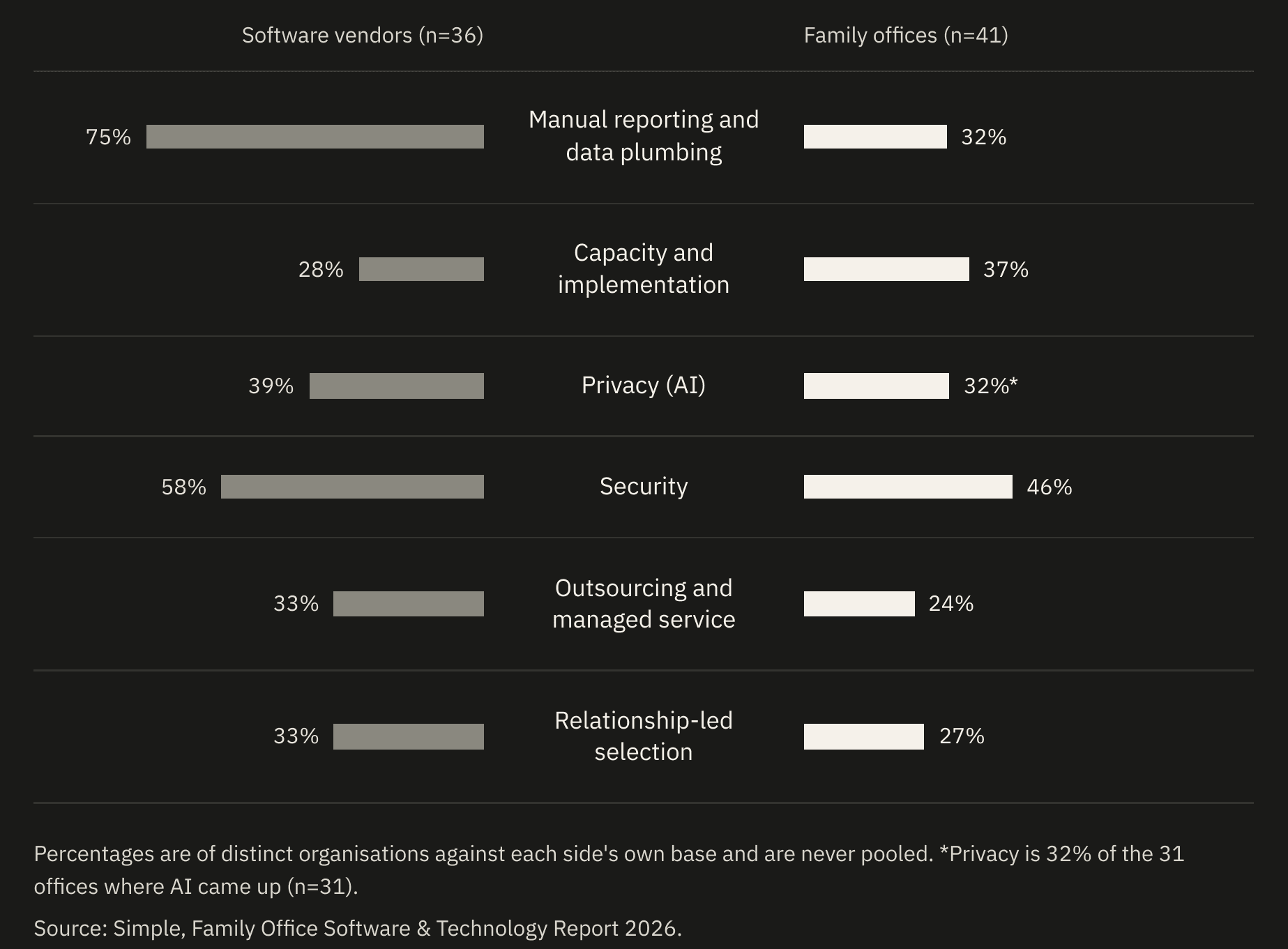
| Theme | Family offices | Software providers | Where they land |
|---|---|---|---|
| Reporting and data | Some still build reports by hand, on top of a platform. Systems don't talk to each other. | Most cite integration pain, mainly bank and custodian feeds. | The hard part is clean data, not AI. |
| Capacity | Many say time, skills and team size hold them back more than appetite. | Implementations take months of the office's own time. | Office capacity is the biggest hurdle. |
| Privacy | Some name privacy as their main AI worry. | Many keep AI inside the platform or away from sensitive work. | Privacy is the AI issue, but no one measures office controls yet. |
| AI | Most use it as an assistant for email, documents and research. | Most offer AI features. Agents and MCP connectors are early. | Supply is ahead of demand. |
| Selection | Some choose through peers and references. | Some win business through referrals and advisers. | Relationships decide. |
| Outsourcing | Some hand IT to outside providers. | Some now sell managed data operations. | Same direction, different layer. |
Three questions from both sides
What makes reporting hard? Offices point to manual work and systems that don't connect. Vendors point to bank and custodian feeds. It's the same problem seen from opposite ends: the data plumbing.
What holds offices back? Offices name time, skills and team size. Vendors name implementations that take months of the office's own time. The shortage is the same: capacity inside the office.
Is it safe to put family data into AI? Offices ask where the data goes. Vendors answer by keeping AI inside the platform or away from sensitive work. Vendors answer the worry by design, but no one yet checks the controls offices actually have.
Introduction
Technology has always been part of innovation for companies, seen alongside people and processes as a way to reach the goals the company was built for. As AI matures and is adopted, this is no different, except for one detail: people can now be augmented by agents, and processes can be automated. This makes AI more of a leadership decision than a tech one.
That is why buy versus build is back on the agenda. The question is not new, but AI coding tools now put building within reach of offices that could never have done it before. Several offices are already experimenting with building, and for many of them it is the first time, so they are still working out how to weigh building against buying. We expect offices to meet the same challenges others have faced with custom builds: what to build, what to buy and what to borrow. Just because you can build does not mean you should.
Last year we wrote that integration and data quality had overtaken visual reporting as the priority, and that AI was moving from aspiration into everyday tools. This year's conversations focus less on which system to buy and more on what it takes to make systems work: clean data, enough people, and trust in where the data goes.
Our sources and method are set out in About this report.
Looking back: how our 2025 calls look a year on
Last year's report made five main calls. Here is how each one looks against this year's evidence.
Table 2
How our 2025 calls look a year on
- Held up
Integration and data quality "have overtaken visual reporting as top priorities", and "integration remains the primary constraint".
Offices and vendors both say the hard part is getting clean data in and between systems.
- Shifted
"AI is shifting from aspiration to infrastructure."
Vendors do ship far more AI, but inside offices it is still mostly an assistant. The gap between what is sold and what is used is this year's story.
- Too early to tell
"Excel reliance is finally falling."
Some offices still put reporting together by hand, but we did not measure spreadsheet use the way the 2025 edition did, so we cannot say whether it is falling.
- Shifted
"Buyers are becoming more operationally mature", with next-generation leaders and Heads of Operations running "structured evaluations".
In our conversations, references and relationships carry much of the choice, and selection looks structured mostly where an adviser runs it.
- Held up
Adoption barriers are "cultural and resource-based, not financial": limited internal capacity and resistance to change.
Capacity, not appetite, is still the biggest hurdle. Cost and contract terms also shape what some offices choose.
Reporting: the data plumbing is the hard part
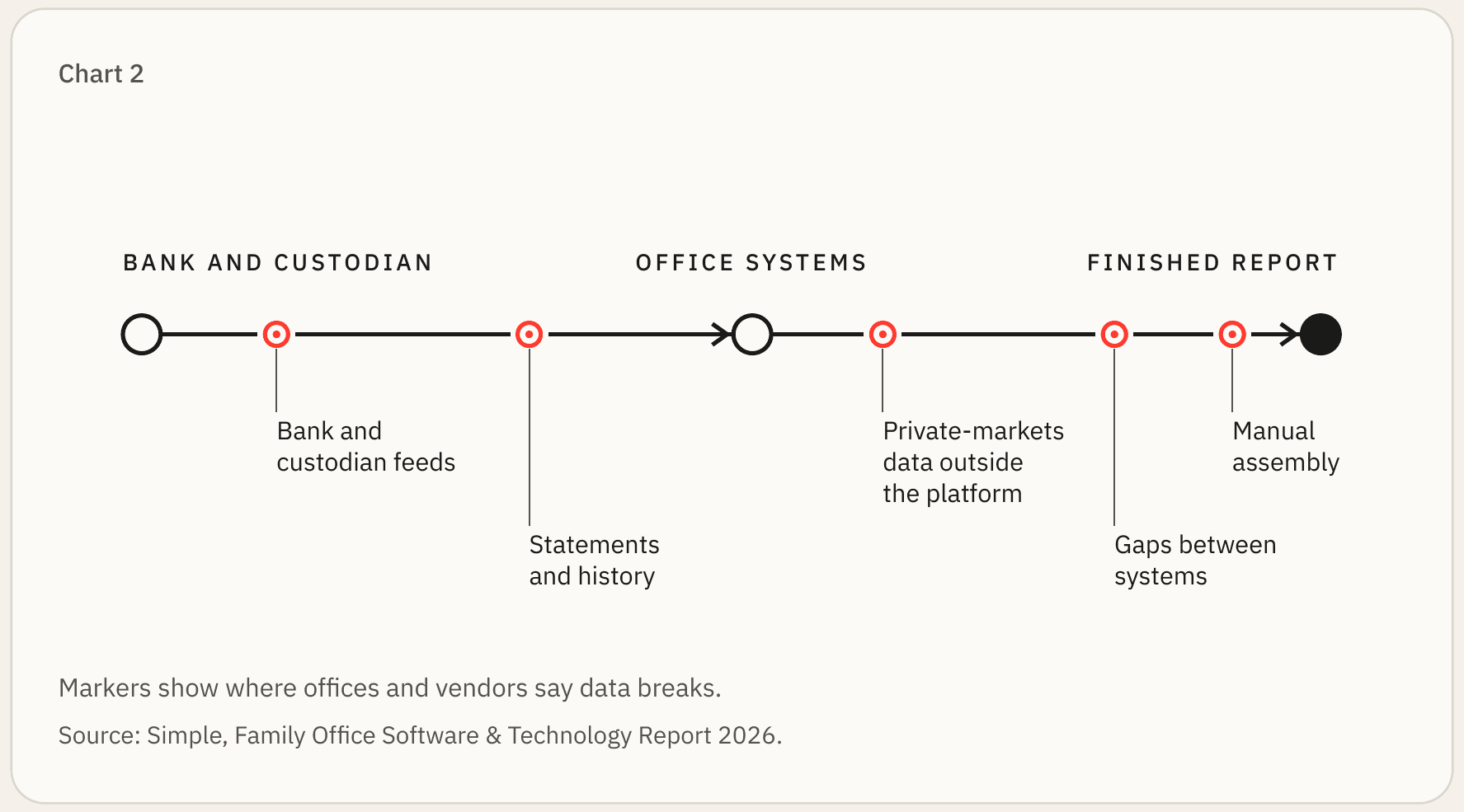
Reporting platforms are spreading, but some offices still put reporting together by hand on top of them. Offices and vendors point to the same place. The hard part is getting clean data in and between systems. Vendors point mainly at bank and custodian feeds, statements and history. In some offices, private-markets data sits outside the main platform. Systems that should talk to each other often do not, so people move data between them by hand.
And I think historically we've done this reporting internally, but it's been so manual that by the time we've finished updating the report, it's out of date. So we used to have these PowerPoints where there'd be a slide for every investment. But again, we've put [a reporting platform] in to try and help with some of this, but I don't think it does everything you need to.
Single-family office, Europe
We just realized some of our data was not structured correctly. So I've been working on a month long project to reconcile and clean up all the feeds that have been coming in very manual.
Single-family office, North America
We tried to kind of get the two [vendor] softwares to talk to each other, but it turns out they don't. In the front office, we have nothing.
Single-family office, Latin America
This is not an AI problem. Besides the abundance of manual work, several offices say they want clean data and a reliable system of record before they trust AI with anything.
What tech providers think
AI has accelerated these conversations, but the underlying priority remains the same: trusted data, seamless integration and tangible operational value.
Reporting software provider.
Family Offices live in a data paradox - data is everywhere but often wrong.
Reporting software provider.
Usually in-house means xls-based and then the maintenance of all the various sheets gets very cumbersome.
Reporting software provider.
Capacity and skills are the main hurdle
Appetite is not the problem. Time, skills and team size are. Family offices are small, and a new system takes months of the office's own time. Vendors typically quote two to four months to implement, longer with a lot of history or many banks, and they say offices often do not know what a good set-up looks like. This is what slows projects down: offices are learning what they need to know while they implement.
There was a bit of a stall and a delay because I'm very busy in the beginning of the year because then I have no time whatsoever. But I nor any of the other financial people have time in the first quarter.
Single-family office, Europe
Some offices rely on one or two power users who know the systems well. When that person is busy or leaves, progress stalls. Cost and contract terms also shape which tools offices choose.
What tech providers think
Clients are less interested in what software can theoretically do and more focused on measurable efficiency gains, reduced operational dependencies and the ability to scale without adding headcount.
Reporting software provider.
They think they can leverage their people and AI. But without the fundamental and structural expertise, they are unable to be successful at that.
Accounting and reporting software provider.
AI in the workplace: real, but mostly at assistant level
The offices we speak with mostly use AI as an assistant: drafting email, reading documents and helping with research. In practice, most of this is copy and paste: moving text from one tool to the next and asking a chatbot. It is not yet a flow in which different tools pass work to each other automatically. Document intake is a common first target for AI, and both offices and vendors say so. Some offices go further and build their own tools with AI coding assistants, which section 7 covers. Some offices have tried AI pilots that fell short on quality.
So it's still just prompt for prompt
Single-family office, Europe
In the written replies to our outreach, some offices go beyond task level, with agents or tools they built themselves. Those replies answer a question about AI, so offices already using AI are likely to be over-represented.
Vendors sell AI hard. Most describe AI features, live or planned, and some talk about agents and connectors to AI tools. Much of that advanced work is early or in pilot, and offices are still asking where AI should start. Vendors themselves are split on how strong office demand is.
Where AI sits today
| Theme | Family offices (n=31) | Vendors (n=36, multi-select) |
|---|---|---|
| AssistantA person prompts each step | 55% | 22% |
| TaskAI completes a defined job and a person checks it | 23% | 47% |
| AutonomousAgents act without per-step approval | None seen | 22% (claimed / pilot) |
Source: Simple, Family Office Software & Technology Report 2026.
The office count covers calls only. In the written replies to our outreach, some offices describe agents they built themselves.
What tech providers think
Many Family Offices are now more aware that adopting AI is not as simple as they may have thought when they tried to implement on their own.
Reporting software provider.
"AI" - even if they did not know what they might use it for or what the implications for data sharing/security, they asked if we 'do it'.
Reporting software provider.
Building in-house: buy the plumbing, build the view
Some offices now build their own tools with AI coding tools, often for the first time. They are not sure how to weigh building against buying. What they build, a front end on vendor data or a replacement system, is still open. Vendors warn against building your own system of record, but a few now offer feeds and APIs so that offices can build their own front end.
Cost is part of that weighing. Offices often compare a build with a subscription fee and leave out the time it takes to build and maintain it. Even so, offices can now get to a range of solutions at lower cost than before.
For offices building for the first time, treating a build as a product is new. We expect product management, owning what gets built, maintained or bought, to emerge as a role inside family offices.
What a build delivers also depends on what the AI can reach. Many teams still feed AI one task at a time: find the problem, pass it over, ask for a fix. That makes the person a conveyor belt for the tool. The better approach is to give the AI controlled access to the underlying data and systems and let it work out what needs doing. Saved instructions and skills help less than people expect, because they can carry habits from older models.
| Tends to work | Tends to break |
|---|---|
| The view: dashboards and front ends on top of data the office already has | Data plumbing: feeds, reconciliation and history |
| Analytics the office wants to own | Maintenance and scale, as accounts and entities grow |
| Narrow tools with a tight scope | Dependence on one key person who built or runs it |
| Missing skills, and no clear owner |
What tech providers think
An in-house build handles the first twenty accounts fine. By account eighty it's one person's full-time job, and when that person leaves, the system leaves with them.
Reporting software provider.
Usually the build works for year one and gets expensive in year three, when the person who built it has moved on and the family still needs accurate numbers every quarter.
Reporting software provider.
Additionally, it breaks down unless there is continuity of knowledge about the in-house solution that allows the reporting to survive a change of person producing it.
Reporting software provider.
Privacy is the main AI worry
In our calls, when offices talk about AI risk, they talk about privacy. Is it safe to put family data into an AI tool, and where does that data end up? Questions about cloud versus on-premise hosting come up for the same reason. The written replies to our outreach point the same way: most of the offices that replied raise privacy or control concerns.
Privacy should not be the only concern. In our view, offices should also weigh emerging cyber risks and how to secure the tools they build themselves. We also think AI can help offices navigate, and even reduce, non-financial risks such as key-person and succession risk.
We should have come up with a plan to address the issue of the data protection. We're currently facing and we're asking ourselves how to manage that because the data we're dealing with are not our own data.
Multi-family office, Europe
Should we be worried about the data leakage into the global web? Because it sounds like the interface looks like popular AI interfaces to me. Maybe I'm biased. Maybe I spent too much time on AI recently.
Single-family office, Asia-Pacific
Many vendors try to keep AI use inside their own platform or the client's environment, or out of sensitive work, and sell data sovereignty as part of the pitch. Some have also started opening up to MCP connectors, and we expect tools will need to open up further to keep their clients. What nobody measures yet is the controls offices actually have in place.
| Control | What it looks like |
|---|---|
| Policy first | The office agrees how AI may be used before tools go live. |
| Vetted or approved tools | Staff use only tools the office has checked and approved. |
| Data segmentation | Sensitive data is kept apart from what AI tools can see, or AI runs in a closed environment. |
| Traceability | The office can see what the AI did and where an answer came from. |
| Human review | A person checks AI output before it is used. |
| Running models locally or on site | AI runs on the office's own systems or premises rather than in a public cloud. |
Offices talk openly about their privacy worries, but rarely about how AI is actually used day to day. From what they report, we cannot tell whether use runs ahead of policy.
We needed a formal AI usage and governance policy in place first which listed which platforms were approved and all users needed a corporate account. Then we needed to ensure we had a team or enterprise subscription. Additionally, we segmented which data could be input to a model, anonymized before input, or completely excluded from model use.
Single-family office, North America
Closed circuits are required to ensure that client identifying data does not become publicly available.
Family office
What tech providers think
Who can see what, where the data goes, and what an agent is allowed to do become hard questions when it is the family's entire wealth.
Reporting software provider.
MCP connectivity, AI features streamlining the operations of alternative assets, cleaned, structured and consumable data, even more focus on info.security and where data is stored.
Reporting software provider.
Security: a worry and a buying criterion
Security and data protection come up often, both as a concern and as something offices check when they choose software. Vendors meet this by selling security through hosting and jurisdiction: where the data sits and under which rules.
I think we have a pretty good security architecture today. I know [a colleague] spends a lot of time ensuring that we're safe and secure. But if we were to go down a path of looking at an enterprise level, you know, the relationship with [an AI provider], you know, does that necessitate a change in that kind of whole security architecture? I'm way out of my depth when we get into this world of, you know, how do we protect ourselves?
Single-family office, North America
Security now needs a modern approach that draws on enterprise practice: identity management, multi-factor authentication, security layered over each tool, and identity-based access to each tool.
What tech providers think
Security used to be a question at the end. This year it comes first, often from the family's own security person or an outside IT firm running a formal due diligence review before the principal will even log in.
Reporting software provider.
What goes out and what stays in
Offices hand IT to outside providers. Reporting appears to stay in, although the picture for accounting is mixed. Offices rarely say why they outsource. IT providers can help put a chosen set-up in place, but the direction of what to implement has to come from the office.
What we want to really build is a very lean organization, which means we will not have IT staff or a bunch of those resources. So part of what we want is to be able to bring together the right set of people for managing a project or getting the technology stack up and running and outsource as much as possible and keep to a very lean staff.
Single-family office, Middle East
Vendors are moving into that space. A number of them now offer managed data operations alongside the software, from daily reconciliation teams to an outsourced back office. Offices describe outsourced IT, while vendors sell outsourced data operations. It is the same direction at a different layer, and it is still emerging.
Buyer behaviour and decision dynamics
References and relationships play a large part in how software is chosen. Offices want to know what other family offices use, and which platform to pick, keep or switch to. Vendors say the same: their business comes through referrals, relationships and advisers. The next generation is starting to shape the technology agenda and the buying path.
Selection looks structured mostly where an adviser runs it. We cannot yet say how offices choose when no adviser is involved, because many of our conversations sit inside selections that Simple runs.
They were recommended by our IT provider. So [our IT provider] provides our IT and this came recommended through them. So we didn't kind of go out and do our own search. We kind of tried to work with someone that our IT provider recommended.
Single-family office, Europe
The providers will, you know, naturally will offer, you know, references, et cetera, but like it'll be good to, to get the sense for more independent things.
Single-family office, Europe
| Reason |
|---|
| The software did not fit, or the vendor did not deliver |
| The office built it with AI instead |
| Organisational change |
| Stepping back to review the whole stack |
| The cost did not justify the benefit |
Some projects start with organisational change, such as growth or a more professional set-up. Some offices also settle governance and their operating model before they choose technology.
Emerging signals
Two signals come mainly from vendors. Neither is a finding yet.
- Pricing not based on AUM. Some vendors are moving away from pricing by assets under management, and say complexity, not asset size, decides fit. AI companies are introducing new ideas such as token-based pricing, which may push this further.
- Growth in the Middle East. A few vendors say they see growth in the Middle East. This is a vendor claim, not a finding. Only a handful of the offices we spoke with are in the Middle East or Africa, and our sample leans towards Europe, so whether the region is growing remains an open question.
What we've learned this year
The tools exist. What holds offices back sits underneath them: data that does not flow cleanly, small teams with little spare time, and open questions about privacy and security. Vendors are answering with more AI, more sovereignty and more managed services. Offices are moving more slowly, and on their own terms. That gap between what is sold and what is used runs through the whole report. AI coding tools less than two years old have already changed how the market behaves. It is still early days, and there are real gaps in moving AI experimentation into the real world.
Outlook 2027
Vendors have shipped AI faster than most offices have taken it up. The question for 2027 is whether office demand catches up, and on what terms. We expect it to happen slowly, one office at a time, led by the power users who already work this way.
Build decisions will change. Deciding whether to build a tool used to mean weighing the build time, the ongoing maintenance and the opportunity cost before committing. AI coding tools shorten that loop, because an office can get to a working version quickly and judge the real thing instead of an estimate. Open source adds to this, since more tools can start from an existing open base, and AI tooling can now rebuild existing tools. That puts pressure on vendors whose products are mainly a view on data the office already owns. The plumbing underneath stays hard, which is why we're watching whether managed data operations become a category of their own.
Most of the value from AI today still comes from automation: taking away tasks that are costly or that keep people from their real work. The bigger change is augmentation, where AI lets a small team do work it couldn't do by hand because it lacked the skills or the time. Capacity is the main hurdle for family offices, so this matters more for them than for most.
Getting there means giving AI access, not more instructions. The offices that get the most from AI will let their tools reach the data and systems the work depends on, with controls around that access, instead of passing over one task at a time. That makes controls the question to watch: what offices put around AI, who owns it, and whether policy keeps up with use.
Not sure where to start? Simple's free AI Advisor at advisor.andsimple.co helps family offices talk it through in about ten minutes and leave with three things they can do today.
Open questions (not findings)
- Who actually handles cyber for family offices? Published reports say it is often outsourced, but our conversations rarely say.
- Do offices invest in AI more than they use it? Our conversations cannot test this.
- How do offices choose software when no adviser is involved?
- Does AI use in family offices run ahead of policy? Offices talk openly about their privacy worries but rarely describe how AI is used day to day, so our conversations cannot say.
The questions we heard most often
These are the questions family offices put to us most often in our calls this year, paraphrased and anonymised.
Choosing and paying for systems
- Which system is right for an office like ours? Should we run one platform or several, and should we keep what we have or switch?
- What will a new system cost, how is it priced, and what do we actually get for the money?
- What will AI cost us, and how does it compare with the software subscriptions we already pay for?
- How does the cost of technology change in an AI era?
- What makes sense to build ourselves today, and what should we buy?
Learning from other offices
- What are other family offices doing, and what has worked for them?
AI in the office
- Where should we start with AI, and what can it realistically do in an office like ours?
- How do we get our team, and the next generation, to use AI well?
Security and privacy
- Is it safe to put our data into AI tools? Where does it go, and who can see it?
- Can we keep our data, and the AI we use, on our own systems, or does it have to go to the cloud?
Start here
Make a plan for your own office
Talk it through with our AI. It asks where your office is today and writes up what you can do next, in your own words.
Start the conversationAbout this report: research methodology
This edition combines published market reports on family office technology with Simple's own work with the market. Over the last year, around 300 people attended our workshops. We gathered qualitative input from 57 family offices and deep insights from 44 software vendors, through a combination of calls, workshops and surveying, between September 2025 and October 2026. Our platform has more than 12,000 users. Each chart uses its own base, shown as n.
The published reports we read alongside our own work:
- Citi Private Bank, Global Family Office Report 2025 and 2026
- Citi Institute with Citi Wealth, AI in the Family Office
- UBS, Global Family Office Report 2025 and 2026
- J.P. Morgan Private Bank, 2026 Global Family Office Report
- Goldman Sachs, Adapting to the Terrain: Family Office Investment Insights (2025)
- BNY Wealth with The Harris Poll, 2025 Investment Insights: Single Family Offices
- BlackRock with Illuminas, Global Family Office Report 2025
- RBC and Campden Wealth, North America Family Office Report 2025 and 2026
- AlTi Tiedemann Global and Campden Wealth, Family Office Operational Excellence Report 2025, and the 2026 early insights
- Ocorian, 2026 Global Family Office Report
- KPMG Australia and The Table Club, Australian Family Office: the role of technology
- DBS Private Bank with FT Longitude, Refocusing resilience
A point counts as a finding only when it shows up in at least two of the three sources and is raised by at least three different offices. Vendor calls tell us what is being built and sold. They support or challenge what offices say, but we never treat them as evidence of what offices do. We do not pool figures across sources.
Frequency words are counted against each side's own base and never pooled: family offices (41, or 31 where AI came up) and software providers (36). Most means over half; many, over a third and up to half; some, over 15% and up to a third; a few, 15% or less. A value exactly on a boundary takes the lower word.
One caution. The offices we speak with are usually already looking at technology, and many vendor conversations take place inside selections that Simple runs. Our findings describe what we hear in these conversations, not the whole market. Family office quotes are anonymous. Some of the software providers we spoke with are Simple partners; they are listed in the Acknowledgements at the end of the report.
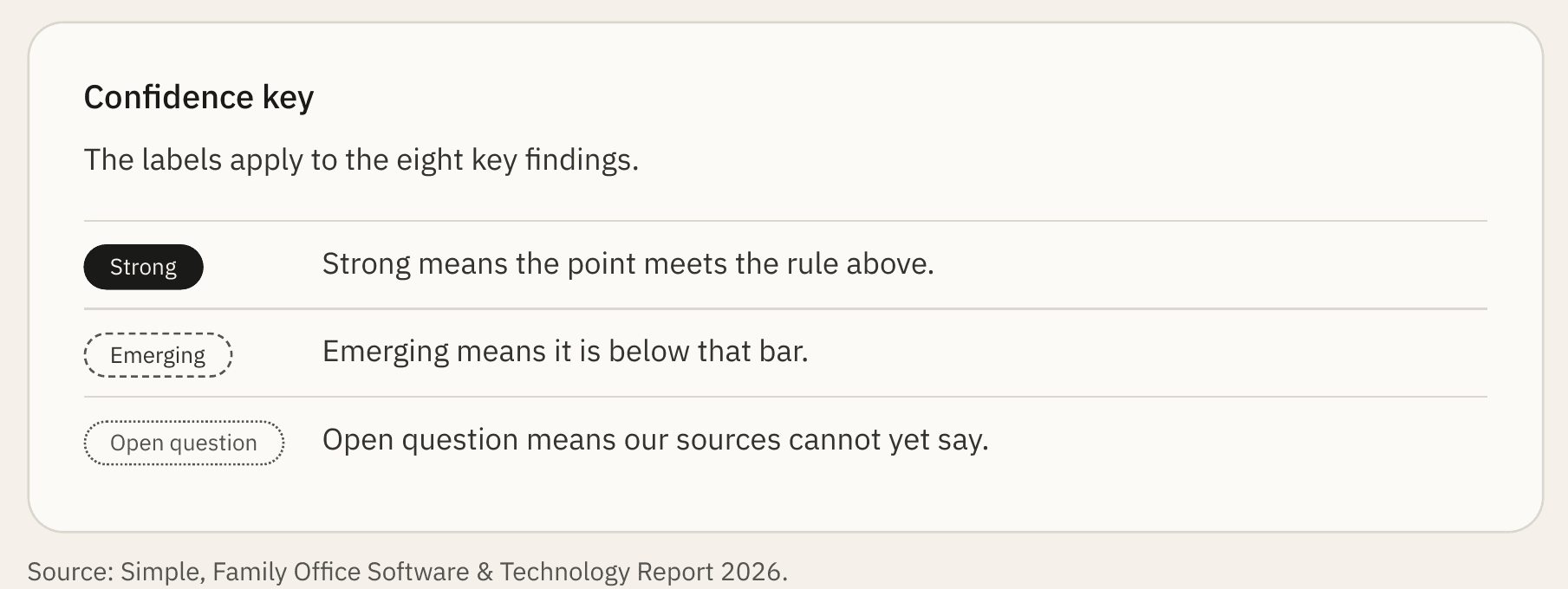
The labels apply to the eight key findings. Strong means the point meets the rule above. Emerging means it is below that bar. Open question means our sources cannot yet say.
Acknowledgements
Thank you to the family offices, advisers, practitioners, strategic discussion partners and friends who discussed these topics with us this year, in calls, workshops and written replies. They spoke openly, and their names stay private.
Thank you also to the technology providers who told us what they build, sell and see in the market.
Simple partners. The providers below are Simple partners, each linked to its page in the Simple directory. Not every partner contributed to this report, and some contributors are not partners.
Cite as: Simple, Family Office Software & Technology Report 2026 (2026), https://andsimple.co/reports/family-office-software
- Addepar
- Aleta
- Altoo
- Alwy
- Archway
- Asora
- Asset Vantage
- Asseta
- Auria
- Black Diamond Wealth Platform
- CFO Family
- DAPM
- DiliTrust
- Duende Ventures
- Elysys
- Eton Solutions
- Etops
- Flanks
- FundCount
- Greenlock
- IQ-EQ
- Landytech
- Masttro
- MSCI
- Nines
- Northern Trust Family Office Technology
- Pretim
- QPLIX
- SumIt
- Swimbird
- Unlimited.ai
- Vyzer
- WealthArc
- WealthSpectrum
- WIZE
In the full report
17 sections
Log in to keep reading
This report is available to all Simple members. Log in or create a free account to read the full report — you'll return here afterwards.
Download
Members-only download
Create a free account to download this report.
Log in to download the full AI-ready Markdown.
How can we help you?
The Simple team works across five global cities. Reach us directly below or send a message and we'll be in touch within one business day.